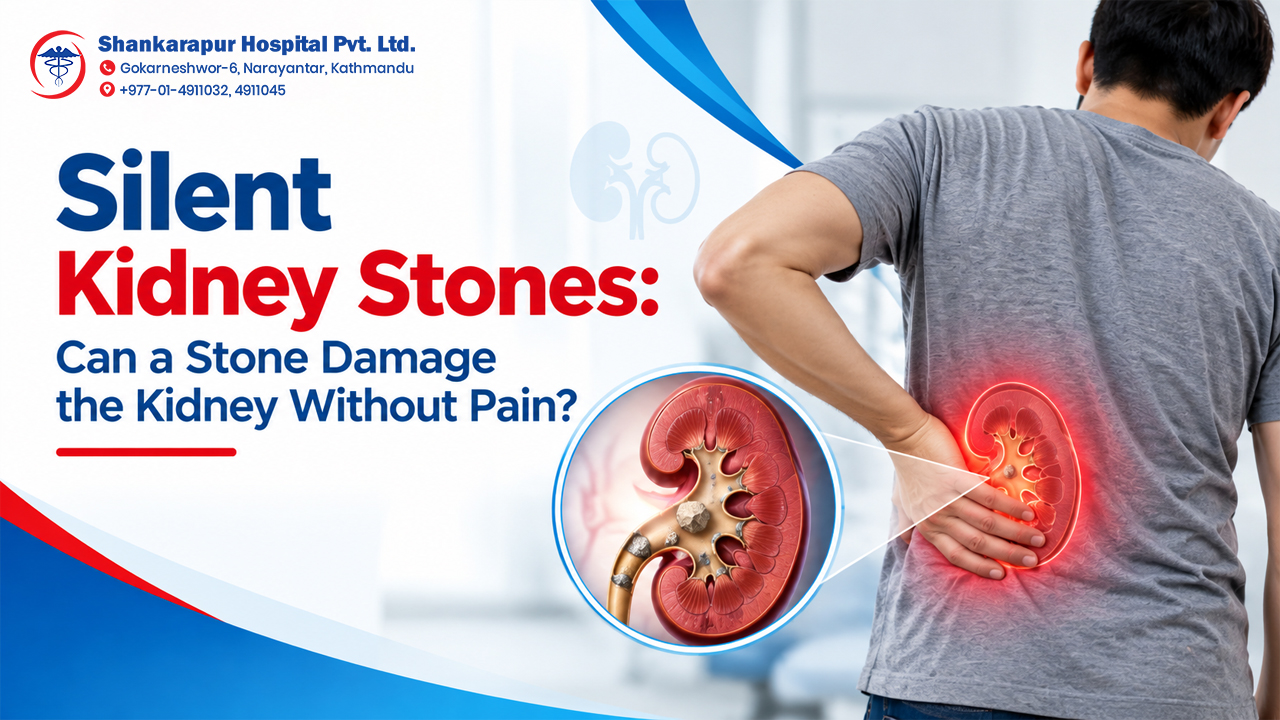
Yes. A kidney stone can sometimes affect the kidney even when it causes little or no pain, particularly if it obstructs urine flow, contributes to infection, continues to grow, or is associated with declining kidney function. However, this does not mean every silent kidney stone is dangerous or requires surgery.
Many small, non-obstructing stones remain stable and can be monitored. The important question is therefore not simply, “Does it hurt?” but rather: Where is the stone, how large is it, is it blocking urine, is the kidney swollen, is infection present, and is kidney function being affected?
That distinction is why an incidentally discovered kidney stone should not automatically be ignored just because it is painless.
What Are Silent Kidney Stones?
Silent kidney stones are stones in the kidney or urinary tract that cause no obvious symptoms.
Doctors may refer to them as asymptomatic renal stones or asymptomatic renal calculi. They are often discovered unexpectedly during an ultrasound, CT scan or other imaging test performed for an unrelated reason.
Kidney stones are hard deposits formed from minerals and other substances in urine. Some remain within the kidney without interfering with urine drainage. Others can grow, move or enter the ureter the tube carrying urine from the kidney to the bladder.
A stone that remains small and does not obstruct urine flow may cause no symptoms at all. The U.S. National Institute of Diabetes and Digestive and Kidney Diseases notes that a small stone may travel through the urinary tract with little or no pain.
The absence of pain therefore cannot tell us everything about a stone.
Can Silent Kidney Stones Damage the Kidney Without Pain?
Yes, in some circumstances. The main concern is not the stone merely being present; it is what the stone is doing to the urinary system.
Kidney stones may threaten kidney function when they produce:
-
persistent urinary obstruction
-
hydronephrosis, or swelling caused by backed-up urine
-
infection behind an obstruction
-
recurrent urinary infections
-
progressive stone growth
-
damage associated with certain high-risk stone diseases
-
problems in someone with a solitary functioning kidney or already impaired kidney function
NIDDK lists urinary tract infection and loss of kidney function among potential complications when kidney stones are not appropriately treated. The European Association of Urology also explains that stones can compromise renal function through obstruction or infection.
At the same time, kidney stones are not automatically synonymous with kidney damage. Many asymptomatic, non-obstructing stones can be safely observed after appropriate evaluation.
How can a stone block the kidney?
Urine produced by the kidney normally drains through the renal collecting system into the ureter and then into the bladder.
If a stone moves into a narrow part of this drainage pathway and becomes lodged, urine may have difficulty passing around it.
Pressure can then build above the blockage.
This may cause hydronephrosis, which means dilation or swelling of the kidney’s urine-collecting system.
A complete obstruction often produces symptoms, but obstruction is not always complete. Partial obstruction may sometimes produce mild, intermittent or even minimal symptoms.
The clinical issue is therefore whether urine is draining normally not simply whether pain is present.
Why does prolonged obstruction matter?
A kidney functions by filtering blood and producing urine. Persistent obstruction places pressure on the urinary collecting system and can interfere with normal kidney function.
How much function is affected depends on factors including:
-
whether obstruction is partial or complete
-
how long it has been present
-
whether one or both kidneys are involved
-
whether infection is present
-
the person’s baseline kidney function
-
whether the other kidney functions normally
Obstructive uropathy can eventually cause irreversible renal injury if treatment is delayed long enough. The degree and reversibility of kidney impairment depend substantially on the severity and duration of obstruction and whether infection is present.
This is one reason a painless stone with evidence of obstruction may be more important than a small painful stone that is moving normally through the urinary tract.
Why Can Kidney Obstruction Sometimes Occur Without Severe Pain?
Kidney-stone pain usually becomes intense when a stone moves into the ureter, causes acute obstruction or triggers ureteral spasm.
Pain is therefore influenced by location, movement and the speed with which pressure changes occur.
A stone sitting inside the kidney may remain completely unnoticed. Slow or partial obstruction can also present differently from sudden complete blockage.
This creates an important misconception:
No pain does not automatically mean no obstruction.
Conversely, severe pain does not automatically mean severe kidney damage. A small moving ureteric stone can be extremely painful while still being likely to pass, whereas another stone may create clinically important obstruction with relatively modest symptoms.
Pain intensity alone is therefore not a reliable measurement of kidney function.
Imaging and, when appropriate, laboratory testing provide much more useful information.
How Are Silent Kidney Stones Usually Discovered?
Many asymptomatic stones are detected incidentally.
For example, a person may undergo abdominal ultrasound or CT imaging because of:
-
an unrelated abdominal complaint
-
a general health assessment
-
urinary infection
-
blood detected in urine
-
another kidney or bladder concern
-
follow-up of a previous stone
-
imaging for an entirely different medical problem
The scan may then reveal one or more renal stones.
Once a silent stone is found, the next step is not automatically surgery.
The first task is risk assessment.
Clinicians generally want to determine:
-
the stone’s size
-
its exact location
-
whether there is one stone or several
-
whether the stone has grown
-
whether urine drainage is obstructed
-
whether hydronephrosis is present
-
whether infection is present
-
whether kidney function is normal
-
whether the patient has one or two functioning kidneys
-
whether there is a history of recurrent stones
These factors help distinguish an incidental finding suitable for surveillance from a stone needing more active management.
What Makes a Silent Kidney Stone More Concerning?
Not all asymptomatic stones carry the same risk.
| Finding | Why it matters |
|---|---|
| Small, stable, non-obstructing renal stone | May often be monitored |
| Stone increasing in size | Suggests progression |
| New urinary obstruction | Can threaten renal drainage |
| Hydronephrosis | Suggests impaired urine outflow that needs explanation |
| Repeated urinary infection | Infection may complicate stone disease |
| Infection plus obstruction | Urological emergency |
| Declining kidney function | Requires prompt evaluation |
| Stone in a solitary functioning kidney | Less reserve if obstruction develops |
| Large stone burden | Lower likelihood of spontaneous resolution |
| Recurrent stones | May justify metabolic evaluation and prevention planning |
The European Association of Urology identifies stone growth, new obstruction, associated infection and acute or chronic pain as reasons to consider active treatment of renal stones.
Stone size matters but it is not the only factor
It is tempting to judge a stone only by millimetres.
Size is important because larger stones are generally less likely to pass spontaneously and may be more difficult to manage conservatively.
But a stone’s location and effect on drainage can be just as important.
A relatively small stone positioned at a critical narrowing may obstruct urine. A larger stone located inside a calyx may, in selected circumstances, remain stable and non-obstructing.
That is why treatment should be individualized.
Stone growth matters
A previously asymptomatic stone that is becoming larger is different from one that has remained unchanged.
Growth may alter the chance of future obstruction, symptoms or the need for intervention.
For people undergoing observation, follow-up imaging therefore serves a purpose: it determines whether the clinical situation remains low risk.
Infection changes the situation
Stones and infection can interact in several ways.
Some types of stones develop in association with urinary infection, while existing stones can also complicate urinary drainage.
The most important emergency is infection in an obstructed urinary system.
The EAU describes an obstructed kidney with signs of urinary infection and/or anuria as a urological emergency. Urgent drainage may be needed before definitive stone removal.
Anyone with a known or suspected kidney stone who develops fever, chills or signs of serious infection requires prompt medical assessment rather than routine watchful waiting.
Do All Silent Kidney Stones Need Treatment?
No. Many asymptomatic renal stones do not need immediate removal.
Observation can be appropriate when a stone is non-obstructing, clinically stable and not associated with infection or deteriorating kidney function.
NICE specifically allows watchful waiting for asymptomatic renal stones after an informed discussion of benefits and risks. The EAU also recognizes surveillance as an option for selected asymptomatic renal stones, although the natural history of such stones is variable.
This means “no surgery now” can be a legitimate medical management decision.
But observation should not be confused with forgetting about the stone.
What does active surveillance mean?
Depending on the patient and stone, surveillance may involve:
-
periodic clinical review
-
repeat ultrasound or another appropriate imaging test
-
monitoring stone growth
-
checking whether hydronephrosis develops
-
assessing kidney function when indicated
-
urine testing where infection is suspected
-
reviewing new urinary symptoms
-
prevention planning for recurrent stone-formers
The exact interval should be individualized by the treating clinician.
A stone that was safe to monitor previously may need a different approach if it grows, moves, begins obstructing urine or becomes associated with infection.
How Are Silent Kidney Stones Evaluated?
Diagnosis usually combines medical history, imaging and selected laboratory tests.
NIDDK states that kidney stones are diagnosed using medical history, physical examination, laboratory testing and imaging. Imaging can reveal both stones and problems such as urinary tract blockage.
Ultrasound
Ultrasound is commonly used to evaluate the kidneys and urinary tract.
It can help identify:
-
some kidney stones
-
kidney swelling
-
hydronephrosis
-
structural abnormalities
Ultrasound avoids ionizing radiation, making it particularly useful in many follow-up situations.
However, it may not define every stone as precisely as CT.
CT scan
A non-contrast CT scan can provide detailed information about urinary stones, including their location and size.
A clinician may recommend CT when greater diagnostic detail is necessary, when ultrasound findings are uncertain, or when treatment planning requires more precise information.
Shankarapur Hospital’s verified Dia.gnostic & Imaging Services page lists both CT scanning and ultrasound.
Urine testing
Urinalysis can help identify:
-
blood in the urine
-
white blood cells
-
bacteria
-
other abnormalities relevant to stone disease
When infection is suspected, further urine testing may be necessary.
Blood testing
Blood tests may be used to assess kidney function and factors related to stone formation.
A creatinine result and estimated glomerular filtration rate may contribute to the assessment of kidney function, but these values must be interpreted clinically.
Importantly, a person can sometimes have a problem affecting one kidney while overall blood kidney-function tests remain relatively preserved because the other kidney is functioning well.
That is another reason imaging can be important.
Can Kidney Function Be Normal Even If One Kidney Is Obstructed?
It can be.
Blood kidney-function tests reflect the combined function of the kidneys rather than providing a complete picture of each kidney individually.
If one kidney is functioning normally, it may compensate enough that a blood test does not immediately show a major abnormality from a unilateral problem.
This does not mean imaging abnormalities should be ignored.
The significance depends on:
-
severity of obstruction
-
duration
-
anatomy
-
function of the affected kidney
-
health of the opposite kidney
-
infection status
Clinicians therefore interpret blood tests together with imaging and the overall clinical picture.
When Should a Silent Kidney Stone Be Treated?
Treatment becomes more likely when the risks of continued observation outweigh the risks of intervention.
Important reasons may include:
1. The stone is causing obstruction
New or persistent obstruction is a recognized reason for active treatment.
If urine cannot drain adequately from the kidney, restoring drainage becomes more important than whether the patient currently feels pain.
2. The stone is growing
Documented stone growth during surveillance may change the management plan.
Growth can increase the probability of future symptoms, obstruction or technically more difficult treatment.
3. Infection is associated with the stone
Repeated infection or an infected obstructed system requires specialist evaluation.
An obstruction accompanied by infection can require urgent drainage.
4. Kidney function is deteriorating
Declining renal function needs investigation.
The stone may or may not be the only cause, so clinicians must evaluate the full clinical picture rather than assuming every kidney-function abnormality comes from a stone.
5. The person has a solitary functioning kidney
Someone relying on one functioning kidney has less renal reserve if obstruction occurs.
This does not automatically mean every tiny stone requires surgery, but careful evaluation and prevention are especially important.
6. Stone size or position makes future complications more likely
Anatomy, occupation, travel circumstances and access to emergency care can sometimes affect decision-making.
For example, a patient whose work frequently takes them far from medical facilities may discuss the practical risks of future acute obstruction with their urologist.
The treatment decision should balance stone characteristics, kidney health, patient preference and procedural risks.
What Treatments Are Used for Kidney Stones?
Kidney-stone treatment depends on size, location, stone characteristics, obstruction, infection, symptoms, kidney function and patient-specific factors.
Observation
Stable, non-obstructing asymptomatic stones may be monitored.
Observation is an active management strategy when accompanied by appropriate follow-up.
Ureteroscopy
Ureteroscopy involves passing a thin instrument through the urinary tract to locate a stone. Laser energy may be used to fragment it, depending on the procedure and stone.
RIRS
Retrograde intrarenal surgery uses a flexible endoscopic approach to reach selected kidney stones through the natural urinary pathway.
PCNL
Percutaneous nephrolithotomy is commonly used for larger or complex renal stones. Access to the kidney is created through a small tract from the back.
The EAU recommends PCNL as a first-line option for renal stones larger than 2 cm in appropriate patients.
Shankarapur Hospital’s Urology Department publicly lists kidney-stone management including PCNL, URS and RIRS.
Patients wanting a broader discussion of procedures can also review Shankarapur Hospital’s kidney stone treatment options guide.
The most appropriate treatment cannot be selected from stone size alone.
Is Drinking More Water Enough for a Silent Kidney Stone?
Adequate fluid intake is an important part of kidney-stone prevention for many people, but water cannot be assumed to correct an obstructing stone or established hydronephrosis.
NIDDK recommends adequate liquid intake as part of stone management and prevention for many patients, while noting that individual fluid recommendations can differ when other medical conditions are present.
A useful distinction is:
Hydration may reduce the conditions that promote some future stones, but it does not replace assessment of an existing potentially obstructing stone.
Someone with known kidney disease, heart disease or a medical reason for fluid restriction should follow individualized advice rather than forcing excessive water intake.
Can Home Remedies Dissolve Silent Kidney Stones?
There is no universal home remedy that dissolves all kidney stones.
Different stones have different compositions.
Calcium-based stones, uric-acid stones, cystine stones and infection-related stones do not behave identically.
Certain uric-acid stones, for example, may sometimes be managed using medically supervised urine alkalinization, whereas common calcium-containing stones are not simply dissolved by drinking a household remedy.
This is why stone composition and metabolic evaluation matter, particularly for recurrent stone-formers.
Do not delay evaluation of obstruction or infection while attempting home remedies.
What Happens If a Silent Stone Is Simply Ignored?
The outcome varies.
A silent renal stone may:
-
remain stable for years
-
grow slowly
-
move into the ureter
-
begin causing pain
-
pass spontaneously
-
cause obstruction
-
become associated with infection
-
eventually require intervention
The natural history of asymptomatic renal stones is not perfectly predictable. The EAU notes substantial variability in stone growth, symptom development, spontaneous passage and subsequent intervention among patients managed with active surveillance.
This is why there are two equally important messages:
Do not assume every silent kidney stone needs surgery.
But also:
Do not assume every silent kidney stone can be forgotten.
The appropriate middle ground is risk-based follow-up.
What Symptoms Should Someone With a Known Stone Watch For?
A previously silent stone may become symptomatic if it moves or causes obstruction.
Symptoms can include:
-
sudden pain in the side or back
-
pain moving toward the lower abdomen or groin
-
blood in urine
-
burning during urination
-
nausea or vomiting
-
increased urinary frequency
-
difficulty passing urine
Fever or chills are particularly important because they may indicate infection.
Pain is valuable information when it occurs—but the purpose of follow-up is to avoid depending on pain as the only monitoring system.
When Is a Kidney Stone an Emergency?
A stone requires urgent assessment when there is concern about serious obstruction, infection or impaired urine output.
Seek urgent medical evaluation for a suspected or known stone accompanied by:
-
fever or chills
-
inability to pass urine
-
markedly reduced urine output
-
severe or uncontrolled pain
-
persistent vomiting or inability to maintain hydration
-
serious weakness or illness
-
symptoms in a person with one functioning kidney
-
concerning symptoms during pregnancy
-
signs of severe urinary infection
An infected obstructed kidney is a urological emergency. The EAU recommends urgent decompression of the urinary collecting system in patients with sepsis and obstructing stones, with definitive stone treatment generally addressed after infection control.
Shankarapur Hospital publicly lists a 24-hour Emergency & Critical Care service.
Emergency symptoms should not be managed solely through an online article or a routine future appointment.
How Can Future Kidney Stones Be Prevented?
Prevention becomes particularly important for people who have formed stones repeatedly.
General principles often include:
-
adequate fluid intake when medically appropriate
-
avoiding excessive dietary sodium
-
maintaining appropriate dietary calcium rather than automatically eliminating calcium
-
tailoring dietary advice to stone type
-
evaluating recurrent stone-formers for metabolic causes when indicated
-
treating relevant urinary infections
-
following prescribed preventive medication when appropriate
-
attending recommended follow-up
A prevention plan should not simply consist of a generic list of foods to avoid.
Different stone types have different drivers.
For recurrent stones, a clinician may consider stone analysis, blood tests or urine studies to better understand why stones are forming.
Observation vs Treatment: A Practical Decision Framework
A useful way to think about a silent kidney stone is to ask four questions.
1. Is the kidney draining normally?
If imaging shows no obstruction or hydronephrosis, observation may be more reasonable.
If urine drainage is impaired, the stone becomes more clinically important.
2. Is the stone stable?
A stone that has remained unchanged is different from one clearly increasing in size.
3. Is the kidney safe?
Kidney function, infection, anatomy and whether the person has one or two functioning kidneys affect the risk.
4. Is surveillance realistic?
Observation only works when follow-up actually occurs.
A plan that depends on repeat imaging is ineffective if the patient never returns.
This framework prevents two common mistakes: unnecessary panic about every incidental stone and excessive reassurance simply because there is no pain.
When Should You See a Urologist for a Silent Kidney Stone?
A urology assessment is reasonable when imaging has identified a renal or ureteric stone and the patient needs to understand whether it is safe to observe.
Questions worth discussing include:
-
What size is the stone?
-
Exactly where is it located?
-
Is it obstructing urine flow?
-
Is hydronephrosis present?
-
Is kidney function normal?
-
Is there any evidence of infection?
-
Has the stone changed compared with previous imaging?
-
Is observation appropriate?
-
When should imaging be repeated?
-
What symptoms should trigger urgent evaluation?
-
If treatment becomes necessary, which procedure best fits this stone?
-
Should recurrence-prevention testing be considered?
For patients looking for a urology hospital in Kathmandu, Shankarapur Hospital is located at Gokarneshor-06, Jorpati, Narayantaar and has a dedicated Urology Department, diagnostic imaging services and emergency support.
The hospital identifies Dr. Wesh Ansari as a Urology & Kidney Transplant Surgeon.
Key Takeaways
Silent kidney stones are real, and absence of pain does not necessarily mean absence of risk.
A small, non-obstructing stone may remain stable and can often be monitored rather than removed immediately.
The main concerns are different: stone growth, urinary obstruction, hydronephrosis, infection and declining renal function.
This is why imaging plays such an important role. Ultrasound or CT can show what pain cannot: where the stone is, whether urine is backing up, and whether the situation remains suitable for observation.
If a stone has been found incidentally, the most useful next question is not “Why doesn’t it hurt?” but:
“Is this stone affecting drainage or kidney health, and what follow-up does it need?”
A urologist can answer that question using the scan findings, kidney function, infection status, stone history and individual risk factors rather than symptoms alone.
Medical-information note: This article provides general educational information and cannot determine whether an individual stone is safe to monitor. Imaging and treatment decisions should be interpreted by an appropriately qualified healthcare professional.