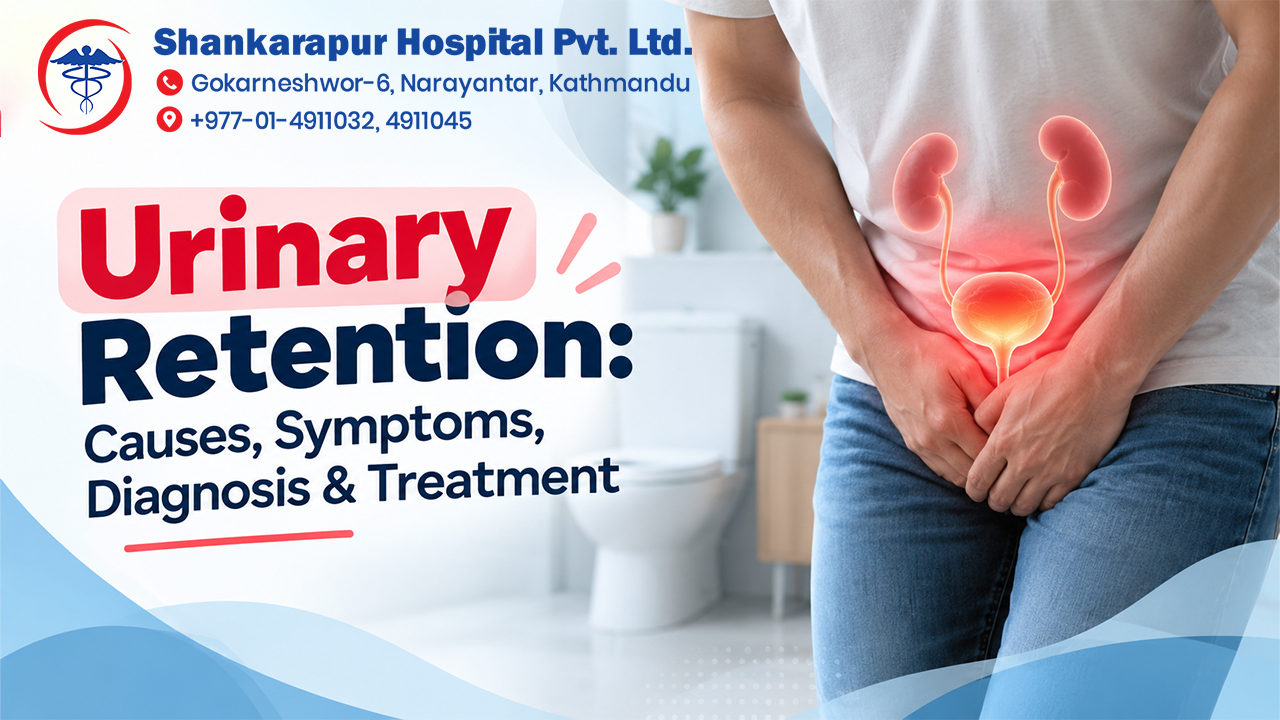
Urinary retention occurs when you cannot empty your bladder completely or, in some cases, cannot pass urine at all. It can develop suddenly or gradually. Sudden, complete inability to urinate is acute urinary retention and requires urgent medical attention, particularly when accompanied by severe lower-abdominal pain or swelling. Chronic urinary retention develops over time and may cause milder symptoms or sometimes few noticeable symptoms at all.
If you are unable to urinate right now despite feeling that your bladder is full, do not try to manage the problem at home. Seek emergency medical care.
What is urinary retention?
Normally, the bladder stores urine produced by the kidneys and then contracts to push urine through the urethra when you urinate. At the same time, the muscles controlling the bladder outlet must relax.
Urinary retention develops when this process is disrupted. There may be a physical obstruction preventing urine from leaving the bladder, the bladder muscle may not contract effectively, the nerves controlling urination may not work normally, or several factors may occur together.
Urinary retention is generally classified as acute or chronic.
Acute urinary retention
Acute urinary retention begins suddenly. A person may feel a strong need to urinate but be unable to pass urine. The lower abdomen may become painful or swollen.
This is a medical emergency because prolonged obstruction and bladder overdistension can cause harm. Treatment usually begins by draining the bladder, commonly with a urinary catheter, while clinicians investigate why the retention occurred.
Chronic urinary retention
Chronic urinary retention develops gradually. A person may still urinate but leave a significant amount of urine behind in the bladder.
Symptoms can be subtle. Some people notice a weak stream, difficulty starting urination or the sensation that their bladder has not emptied. Others may have few obvious symptoms.
There is no single residual-volume number that should be used by patients to diagnose chronic urinary retention themselves. Clinical interpretation depends on symptoms, duration, underlying cause and potential complications. The American Urological Association has used a specific definition for research and clinical-consensus purposes, while also acknowledging limitations in using one PVR threshold universally.
Acute vs. chronic urinary retention
| Feature | Acute retention | Chronic retention |
|---|---|---|
| Onset | Sudden | Gradual |
| Ability to urinate | Often unable to urinate | Usually able to pass some urine |
| Pain | Can be severe | May cause mild discomfort or no pain |
| Urgency | Often intense | May vary |
| Immediate action | Emergency assessment | Medical evaluation is needed, urgency depending on symptoms and complications |
What are the symptoms of urinary retention?
Symptoms depend strongly on whether retention is acute or chronic.
Symptoms of acute urinary retention
Typical warning signs include:
-
Sudden inability to urinate
-
Severe lower-abdominal pain
-
A strong urge to urinate without success
-
Swelling or fullness in the lower abdomen
NIDDK advises seeking medical attention immediately for inability to urinate or severe abdominal pain.
Symptoms of chronic urinary retention
Possible symptoms include:
-
Feeling that the bladder has not emptied completely
-
Passing small amounts of urine frequently
-
Difficulty starting the urine stream
-
A slow or weak stream
-
Needing to urinate again soon after finishing
-
Urgency with little urine passed
-
Unexpected urine leakage
-
Lower-abdominal discomfort
Chronic retention can occasionally produce surprisingly few symptoms, which is one reason persistent changes in urination should not simply be ignored.
What causes urinary retention?
Urinary retention is a symptom or clinical condition rather than one single disease. Finding the cause is essential because treatment differs significantly from one person to another.
1. Blockage of urine flow
A physical obstruction may prevent the bladder from emptying normally.
In men, an enlarged prostate also called benign prostatic hyperplasia or BPH is an important cause. As the prostate enlarges, it can narrow the channel through which urine passes.
Other obstructive causes can include:
-
Urethral stricture or scar tissue
-
Bladder or urinary-tract stones
-
Severe constipation or impacted stool
-
Pelvic masses
-
Pelvic organ prolapse in women
-
Inflammation or infection
-
Trauma involving the urethra or pelvis
NIDDK identifies both obstruction and inadequate bladder contraction as major mechanisms behind urinary retention.
2. Weak or poorly contracting bladder muscle
The bladder muscle known as the detrusor must contract effectively to push urine out.
If it does not contract strongly or long enough, urine may remain in the bladder. This can occur with ageing, prolonged bladder overdistension and certain neurological or medical conditions.
3. Nerve-related problems
Urination depends on coordinated communication between the brain, spinal cord, nerves, bladder and urinary sphincter.
Conditions affecting these pathways can interfere with emptying. Examples described by NIDDK include diabetes, multiple sclerosis, Parkinson's disease, stroke, spinal-cord injury and other neurological disorders.
New urinary retention associated with leg weakness, numbness around the groin or saddle area, severe back pain, or loss of bowel control warrants urgent medical assessment because neurological causes may require rapid evaluation.
4. Medicines
Some medications can interfere with normal bladder contraction or increase resistance at the bladder outlet.
Medication groups associated with urinary retention include certain:
-
Anticholinergic medicines
-
Antihistamines and decongestants
-
Antidepressants
-
Antipsychotics
-
Opioids
-
Benzodiazepines
-
Medicines used for Parkinson's disease
-
Other drugs affecting bladder or sphincter function
Do not stop a prescribed medicine abruptly simply because urinary retention is listed as a possible adverse effect. Instead, tell your doctor or pharmacist exactly what prescription, over-the-counter and herbal products you use.
5. Surgery and anaesthesia
Temporary urinary retention can occur after surgery. Anaesthesia, pain medicines, intravenous fluids, reduced mobility and surgical effects on pelvic tissues or nerves may contribute.
Healthcare professionals commonly consider recent surgery when evaluating a new episode of urinary retention.
Can women develop urinary retention?
Yes. Although urinary retention particularly obstruction associated with prostate enlargement is more common in older men, women can develop it as well.
Potential causes in women include pelvic organ prolapse, pelvic masses, tight pelvic-floor muscles, neurological conditions, medication effects, previous pelvic surgery and other problems that interfere with bladder emptying.
Persistent difficulty urinating therefore deserves evaluation regardless of sex.
How is urinary retention diagnosed?
Diagnosis is not based on symptoms alone. A healthcare professional generally tries to answer two questions:
Is urine remaining in the bladder after urination?
and
Why is the bladder not emptying normally?
Medical history and examination
Your clinician may ask when symptoms began, whether you can pass any urine, how strong your stream is, whether you have pain or fever, what medicines you take, and whether you have conditions such as diabetes, neurological disease, prostate problems or previous pelvic surgery.
A physical examination may focus on the abdomen, urinary tract, nervous system and where relevant the prostate or pelvic organs.
Postvoid residual measurement
A postvoid residual, or PVR, measures how much urine remains in the bladder after you try to urinate.
NIDDK notes that clinicians may measure the residual using a catheter or ultrasound equipment.
The result should be interpreted with your symptoms and clinical circumstances rather than as a standalone self-diagnosis.
Urine and blood tests
Urinalysis may help identify infection or other urinary abnormalities. Blood testing can help assess kidney function or metabolic problems when clinically appropriate.
Additional testing
Depending on the suspected cause, clinicians may consider imaging, urodynamic testing or cystoscopy. Not every person requires every test. The investigation should be tailored to the clinical picture.
How is urinary retention treated?
Treatment depends on whether the condition is acute or chronic and, most importantly, on the underlying cause.
Emergency treatment of acute urinary retention
When a person has acute urinary retention, the immediate priority is generally to empty the bladder.
NIDDK states that healthcare professionals treat acute urinary retention by draining urine using a catheter. This relieves pressure and helps protect the bladder and kidneys while the cause is investigated.
Catheterization is a medical procedure; people should not attempt to improvise it themselves.
Treating the underlying cause
Once the bladder is safely managed, treatment can focus on the reason retention developed.
Depending on the diagnosis, management may involve:
-
Adjusting a medication that contributes to retention
-
Treating infection when present
-
Medicines for prostate enlargement
-
Treatment of urethral narrowing
-
Procedures or surgery for obstruction
-
Management of pelvic organ prolapse
-
Intermittent or longer-term catheter use in selected cases
-
Treatment strategies for neurological or bladder-muscle dysfunction
For prostate-related obstruction, treatments may include medications that relax the prostate/bladder outlet or reduce prostate size, while some patients require procedures or surgery. Treatment selection requires individual assessment.
Does urinary retention always require a catheter?
No.
A catheter is commonly required to relieve acute urinary retention and may also be necessary in some cases of significant or persistent chronic retention.
However, chronic-retention management depends on symptoms, cause and risk. Some people need intermittent catheterization, some require treatment of an obstruction or another underlying disease, and others need monitoring.
Catheters themselves have potential complications, including infection and urethral injury, so their use should be based on clinical need rather than used casually. The AUA chronic-retention consensus specifically emphasizes balancing the harms and benefits of intervention.
What complications can untreated urinary retention cause?
When urine remains in the bladder, it can create conditions that increase the risk of urinary infection and other problems.
Persistent high-pressure or severe retention can potentially affect the upper urinary tract and kidneys in some patients. The AUA identifies hydronephrosis, impaired renal function and recurrent urinary infections among important high-risk findings in chronic retention.
This does not mean everyone with incomplete emptying will develop kidney damage. Risk varies considerably, which is why appropriate assessment matters.
Can urinary retention be prevented?
Not every case is preventable because many underlying causes such as neurological disease, anatomical obstruction or postoperative changes cannot always be predicted.
Practical measures may include taking prescribed medicines correctly, discussing new urinary symptoms after starting a medication, managing relevant medical conditions and seeking evaluation when urinary symptoms persist instead of waiting for complete blockage.
Avoid attempting to “flush out” suspected retention by drinking very large quantities of water. If the bladder cannot empty, simply adding more fluid does not correct the underlying problem.
When should you seek medical help?
Seek emergency care if:
You suddenly cannot urinate despite feeling that your bladder is full, particularly if you have significant lower-abdominal pain or swelling. Acute urinary retention requires prompt medical assessment.
Urgent assessment is also appropriate when urinary difficulty occurs with severe neurological symptoms, significant illness, or other concerning changes.
Arrange medical evaluation if:
You repeatedly experience a weak stream, hesitancy, incomplete emptying, frequent small urinations, unexplained leakage or recurrent urinary symptoms.
Those symptoms do not automatically mean you have urinary retention, but they deserve proper evaluation.
Seeking urinary care in Kathmandu
Shankarapur Hospital has a verified Urology Department covering urinary-tract conditions in men and women as well as prostate-related conditions. The hospital currently identifies Dr. Wesh Ansari as a Urology & Kidney Transplant Surgeon.
The hospital also lists Diagnostic & Imaging Services including ultrasound, and 24-hour Emergency & Critical Care.
For ongoing urinary symptoms, patients can request an appointment with Shankarapur Hospital.
If you cannot pass urine at all, however, treat the situation as urgent rather than waiting for a routine appointment.
Key takeaways
Urinary retention means the bladder does not empty fully or at all.
Acute urinary retention develops suddenly and is a medical emergency. Chronic urinary retention may develop gradually and can be much less obvious.
Common mechanisms include blockage of urine flow, impaired bladder contraction, neurological problems, medicines and postoperative effects.
Diagnosis often includes assessment of postvoid residual urine along with history, examination and additional tests chosen according to the suspected cause.
Treatment is not one-size-fits-all. Acute retention generally requires prompt bladder drainage, while longer-term management depends on the underlying problem.
Medical review required before publication: reviewer name and credentials to be added only after actual clinical review.