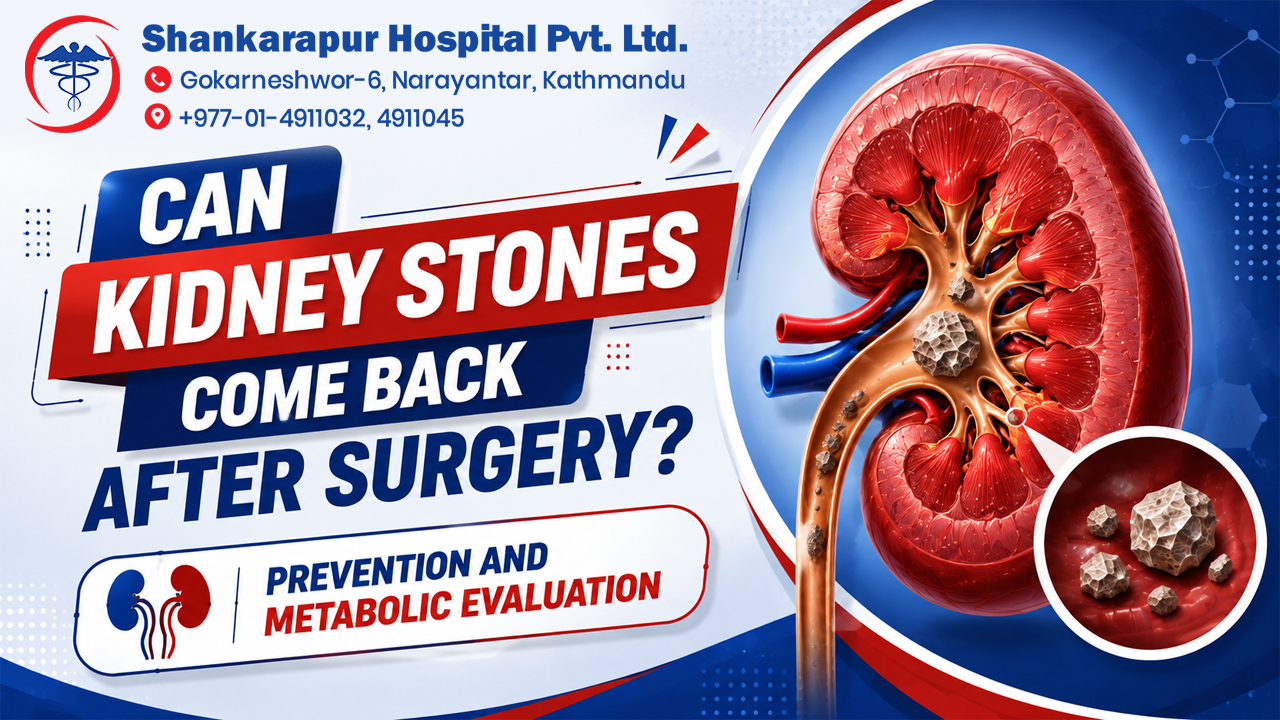
Yes. Kidney stones can come back after surgery or another stone-removal procedure. Surgery can remove or break an existing stone, but it does not necessarily correct the conditions that caused the stone to form. Low urine volume, high urinary calcium or oxalate, low citrate, high uric acid, certain infections, diet, medical conditions and genetic factors may continue after the procedure.
For someone who has already had a kidney stone especially someone with repeated stones the next step is therefore not simply “drink more water.” Identifying the stone type, assessing recurrence risk, considering metabolic evaluation and planning appropriate follow-up can help make prevention more individualized.
This article explains why kidney stones may return after surgery, what a metabolic evaluation involves, what a 24-hour urine test can reveal, and which prevention measures may be discussed with a urologist.
Content evidence reviewed: August 7, 2026.
Medical note: This article is intended for general patient education and does not diagnose an individual condition or replace consultation with a qualified healthcare professional.
Can Kidney Stones Really Come Back After Surgery?
Yes. A person may become stone-free after treatment and later develop another kidney stone.
This can occur after procedures such as ureteroscopy, laser lithotripsy, RIRS, PCNL or shock-wave lithotripsy. The important point is that these procedures treat the existing stone burden. Whether another stone forms later depends largely on the person's underlying stone-forming tendency and whether preventive factors are identified and managed.
The European Association of Urology recommends that stone patients be assessed according to their risk of future stone formation and emphasizes stone analysis and metabolic evaluation as part of recurrence prevention.
Patients who want to understand how different procedures work can also review Shankarapur Hospital's kidney stone treatment options.
Kidney Stone Removal Is Not the Same as Kidney Stone Prevention
One of the most useful ways to understand recurrence is to separate treatment from prevention.
Kidney stone treatment asks:
“How do we safely remove, break or manage the stone that exists now?”
Prevention asks:
“Why did this stone form, and what can be changed to reduce the chance of another one?”
Those are related but different questions.
A laser procedure, for example, may successfully fragment a kidney or ureteric stone. But if the person continues to produce concentrated urine or has high urinary calcium, excessive urinary oxalate, low citrate or another metabolic risk, the environment that allowed the original stone to develop may remain.
That is why the period after stone treatment can be an important opportunity for prevention rather than simply the end of treatment.
For readers specifically researching the procedure itself, Shankarapur Hospital has a separate guide to laser surgery for kidney stones.
Is a Recurrent Kidney Stone Always a Completely New Stone?
No. A stone detected after surgery may represent either new stone formation, growth of a very small residual fragment, or another stone that was already present but not completely cleared.
This distinction matters.
New stone formation
A genuinely new stone forms after the earlier stone burden has been cleared. This is what clinicians typically mean by stone recurrence.
Residual fragments
Some procedures may leave tiny fragments that do not immediately cause symptoms. Some pass spontaneously, while others can remain stable or grow.
Current EAU guidance notes that residual fragments after treatment deserve follow-up because some progress or eventually require another intervention. For fragments of 4 mm or less, reported disease progression at approximately 49 months ranged from 9% to 34%, while intervention rates ranged from 17% to 29%. Larger residual fragments carry a greater likelihood of requiring further treatment.
This is one reason postoperative imaging can matter even when a patient feels completely well.
Why Do Kidney Stones Keep Coming Back?
Recurring kidney stones usually do not have one universal cause. Several factors can work together.
1. Not producing enough urine
Low urine volume makes stone-forming substances more concentrated.
The European Association of Urology recommends fluid intake sufficient to maintain a 24-hour urine volume above 2.5 litres for general recurrence prevention.
The amount a person must actually drink to reach that urine output differs according to climate, physical activity, sweating, health conditions and other factors.
People with heart failure, kidney failure or another medical reason for fluid restriction should not adopt a high-fluid plan without professional guidance.
2. High urinary calcium
Some people excrete more calcium into their urine, known as hypercalciuria.
This does not automatically mean they are eating too much calcium. Urinary calcium can be influenced by sodium intake, metabolic factors and some medical disorders.
An important misconception is that everyone who develops a calcium stone should stop eating calcium-rich foods. That can be counterproductive.
NICE advises maintaining normal dietary calcium rather than routinely restricting it for stone prevention.
3. High urinary oxalate
Oxalate can combine with calcium in urine and contribute to calcium oxalate stone formation.
High urinary oxalate may have several possible causes, including dietary patterns and intestinal absorption disorders. The correct response therefore depends on the patient's metabolic findings rather than simply avoiding every food containing oxalate.
4. Low urinary citrate
Citrate can inhibit calcium-stone formation.
Some stone formers have abnormally low urinary citrate, called hypocitraturia. Identifying it may change the prevention strategy.
5. High uric acid or persistently acidic urine
Uric acid stones are strongly influenced by urine chemistry.
Persistently low urine pH can favour uric acid crystallization. Some people also excrete excessive uric acid.
This is another example of why knowing the stone composition and urinary chemistry can matter more than following a generic “kidney stone diet.”
6. High sodium intake
A high-sodium diet can increase urinary calcium in susceptible calcium-stone formers.
NICE recommends that adults with renal or ureteric stones limit salt intake to no more than 6 g per day as part of recurrence-prevention advice.
7. Some dietary patterns
Dietary prevention depends partly on the type of stone.
NIDDK notes that prevention recommendations can involve adjustments to sodium, animal protein, calcium and oxalate depending on stone type and individual circumstances.
This is why copying another person's kidney-stone diet may not address your own risk.
8. Recurrent urinary infection
Some stones are associated with urinary infection.
Infection stones, including struvite stones, require a different prevention strategy from typical calcium stones. The EAU categorizes infection-stone formers as high risk for recurrence and emphasizes infection control and evaluation of the underlying cause.
9. Digestive or metabolic conditions
Some gastrointestinal disorders, malabsorption states or previous intestinal surgeries can change oxalate handling and urine chemistry.
Other systemic conditions may also contribute to recurrent stone formation.
10. Genetic or uncommon stone disorders
Cystine stones are related to an inherited disorder called cystinuria and have a high recurrence tendency.
Other rare stone types also require specialized evaluation.
For a broader explanation of stone formation, see Shankarapur Hospital's guide to the causes of kidney stones.
Who Should Be More Concerned About Kidney Stone Recurrence?
Every patient with kidney stones benefits from basic prevention advice, but some people require more detailed assessment.
Risk becomes more important when there is:
-
repeated stone formation;
-
a strong family history;
-
stone formation at a young age;
-
multiple or bilateral stones;
-
unusual stone composition;
-
uric acid, infection or cystine stones;
-
metabolic abnormalities;
-
certain gastrointestinal or systemic diseases;
-
recurrent urinary infection;
-
residual stones after treatment; or
-
continued stone formation despite preventive measures.
The EAU recommends classifying stone formers according to recurrence risk. Stone analysis and a basic metabolic evaluation are recommended for all stone formers, while more specific metabolic evaluation is particularly directed at high-risk patients.
The American Urological Association similarly recommends additional metabolic testing for recurrent stone formers and high-risk or interested first-time stone formers.
What Is a Metabolic Evaluation for Kidney Stones?
A metabolic evaluation is a structured assessment designed to identify why a person's urine or metabolism favours stone formation.
It is not one single test.
Depending on the patient's history and stone type, the evaluation may combine:
-
medical and family history;
-
dietary and fluid history;
-
stone analysis;
-
review of imaging;
-
urine testing;
-
blood tests; and
-
one or more 24-hour urine collections.
The goal is not simply to label someone as a “stone former.” It is to identify modifiable abnormalities that could guide targeted prevention.
Stone analysis
If a stone or fragment is available, laboratory analysis can identify its composition.
Major stone categories include:
-
calcium oxalate;
-
calcium phosphate;
-
uric acid;
-
struvite or infection stones; and
-
cystine stones.
Different stones form under different biological conditions, so the composition may change which tests or prevention strategies are most useful.
The EAU recommends reliable stone analysis and basic metabolic evaluation for stone formers.
Blood tests
Blood testing may help identify abnormalities involving kidney function, calcium metabolism or uric acid.
For calcium oxalate stone evaluation, current EAU guidance includes serum assessment of parameters such as creatinine, electrolytes, calcium, phosphate and uric acid, with additional testing such as parathyroid hormone where clinically indicated.
The exact panel should be determined by the treating clinician.
Urinalysis and urine culture
A routine urine test may show blood, pH changes, crystals or evidence suggesting infection.
A urine culture may be appropriate when infection is suspected.
Imaging
Imaging helps determine whether the patient is stone-free, whether residual fragments remain and whether new stone formation is occurring.
Shankarapur Hospital lists CT, digital X-ray and ultrasound among its diagnostic and imaging services. The appropriate modality depends on the stone type, symptoms and clinical question.
What Is a 24-Hour Urine Test for Kidney Stones?
A 24-hour urine test measures substances excreted in the urine over an entire day to identify biochemical conditions that may encourage or protect against stone formation.
The AUA states that metabolic testing may include one or two 24-hour collections assessed for at least:
-
total urine volume;
-
urine pH;
-
calcium;
-
oxalate;
-
uric acid;
-
citrate;
-
sodium;
-
potassium; and
-
creatinine.
Current EAU guidance describes two consecutive 24-hour urine collections for specific metabolic evaluation.
Why not rely on a normal urine sample?
A routine urine sample gives information about urine at one particular time.
A 24-hour collection captures the cumulative excretion of stone-related substances across a normal day, which may provide a clearer picture of metabolic risk.
It is especially useful when clinicians are trying to answer questions such as:
-
Is urine volume consistently too low?
-
Is too much calcium being excreted?
-
Is oxalate elevated?
-
Is citrate too low?
-
Is sodium intake reflected in high urinary sodium?
-
Is urine unusually acidic?
-
Is excessive uric acid being excreted?
The answers can change prevention recommendations.
When should metabolic testing be performed?
Timing matters.
Current EAU guidance advises performing the specific metabolic work-up after the acute episode has settled, when the person is stable, infection-free and back to their usual diet and fluid intake. The guideline notes that this is preferably around three months after the acute episode rather than immediately during the acute illness.
For patients starting medication intended to prevent recurrence, EAU guidance suggests a first repeat 24-hour urine evaluation approximately eight to twelve weeks later so the response can be assessed and treatment adjusted where necessary.
A clinician may choose a different schedule based on the individual case.
A Practical Example: Two Patients, Same Surgery, Different Prevention
Consider a hypothetical example.
Two people undergo RIRS and both become stone-free.
Patient A's evaluation shows low urine volume but no major metabolic abnormality. Their main prevention priority may centre on maintaining adequate fluid intake and monitoring.
Patient B has recurrent calcium stones, high urinary calcium and high urinary sodium. The prevention plan may need to address sodium intake and other metabolic findings rather than simply advising more water.
The surgery was similar.
The prevention problem was different.
That distinction is exactly why metabolic evaluation can add value in recurrent stone disease.
How Can Kidney Stones Be Prevented After Surgery?
There is no single prevention plan that works for every patient.
However, several principles are commonly used.
1. Produce enough urine
Adequate fluid intake is a central component of kidney-stone prevention.
The EAU recommends intake sufficient to achieve more than 2.5 litres of urine per 24 hours.
NICE advises many adults with renal or ureteric stones to drink approximately 2.5–3 litres of water per day, although actual needs and suitability differ.
People who have been given a fluid restriction because of another medical condition should follow their clinician's advice rather than a general internet recommendation.
2. Spread fluid intake through the day
Drinking a very large amount at one time and then going many hours without fluids may be less practical than maintaining hydration throughout the day.
Fluid requirements can also rise with sweating and hot conditions.
3. Reduce excessive sodium
Sodium is especially relevant in calcium stone formers because high sodium intake may increase urinary calcium.
Practical ways of lowering excess sodium can include reducing heavily salted processed foods and avoiding unnecessary additional salt.
A dietitian or clinician can help translate urinary sodium results into realistic dietary changes.
4. Do not automatically eliminate dietary calcium
“Calcium stone” does not automatically mean “avoid calcium.”
Normal dietary calcium can bind oxalate in the intestine, reducing the amount available for absorption.
NICE specifically advises maintaining normal calcium intake rather than restricting it routinely.
Calcium supplements are a separate issue and should be discussed with a clinician when relevant.
5. Adjust oxalate only when appropriate
Some patients with calcium oxalate stones and high urinary oxalate may benefit from targeted dietary changes.
But eliminating every oxalate-containing food is neither necessary nor appropriate for everyone.
The strategy should account for actual urine findings, calcium intake, nutritional quality and any intestinal disease.
6. Moderate excessive animal protein when indicated
Animal-protein intake may affect uric acid and urinary chemistry in some stone formers.
NIDDK recommends that dietary changes be based on the type of kidney stone and may involve adjusting animal protein intake.
This does not mean every patient needs a low-protein diet.
7. Eat more fruits and vegetables where medically appropriate
Fruits and vegetables can contribute fluid, potassium and alkali to the diet.
Some patients with low urinary citrate may particularly benefit from dietary assessment, although supplements or prescription treatment should not be self-started solely on the basis of an online article.
8. Know your stone type
A person with recurrent uric acid stones may need a very different strategy from someone with calcium oxalate or infection stones.
Whenever a stone can be retrieved, ask whether stone analysis is appropriate.
9. Treat infections appropriately
Patients with infection-associated stones need treatment of the underlying urinary infection and appropriate follow-up.
Repeatedly treating pain while ignoring infection can leave an important driver of recurrence unaddressed.
10. Use medication only when indicated
Some recurrent stone formers may be prescribed medication based on stone type or metabolic findings.
Depending on the clinical situation, treatment may involve medications that alter urinary calcium, citrate, uric acid or urine pH.
These medicines require appropriate selection, monitoring and follow-up. They should not be started because another stone patient uses them.
Does Prevention Depend on the Type of Kidney Stone?
Yes. Stone-specific prevention is often more useful than a one-size-fits-all diet.
| Stone type | Examples of factors clinicians may evaluate | Prevention focus may include |
|---|---|---|
| Calcium oxalate | Urine volume, calcium, oxalate, citrate, sodium, uric acid | Fluids plus correction of identified abnormalities |
| Calcium phosphate | Urinary calcium, urine pH, systemic causes | Cause-specific management |
| Uric acid | Low urine pH, uric acid, metabolic factors | Hydration and clinician-directed urine-pH management |
| Struvite/infection | Recurrent infection, residual stone material | Stone clearance and infection management |
| Cystine | Cystinuria, urine volume, pH | Specialist metabolic management and high urine dilution targets |
The table illustrates why the phrase “kidney stone diet” can be misleading. There are several kinds of stones and multiple metabolic pathways.
Can Kidney Stones Return After Laser Treatment, RIRS or PCNL?
Yes.
A successful procedure can clear the treated stone but does not make the kidneys permanently unable to form another stone.
After ureteroscopy or laser lithotripsy
New stones can develop later if the underlying risk persists. Small residual fragments may also remain in some cases.
After RIRS
RIRS can treat stones inside the kidney through a flexible endoscope. Post-treatment recurrence still depends on residual fragments and the patient's underlying stone-forming risk.
After PCNL
PCNL is commonly used for larger or more complex stones. Even after successful removal, patients with metabolic abnormalities, infection-related stones or another high-risk condition may need continued prevention and monitoring.
After shock-wave lithotripsy
Shock waves break the stone into pieces that then need to pass. Residual fragments may sometimes persist.
The procedure used is therefore only one part of long-term risk.
What Follow-Up Is Needed After Kidney Stone Surgery?
Follow-up should answer three broad questions:
1. Is the urinary tract safe after treatment?
Clinicians may need to confirm that obstruction, infection or procedure-related problems have resolved.
2. Is the patient actually stone-free?
Symptoms alone cannot reliably confirm this.
3. What is the future recurrence risk?
Stone composition, history, residual fragments and metabolic findings can influence the follow-up plan.
The EAU notes that follow-up duration and imaging should be adapted to stone characteristics and risk status rather than using one universal schedule for everyone. Ultrasound and plain radiography may be used in selected follow-up situations, while CT is generally reserved when detailed evaluation is clinically necessary because of radiation exposure.
If a new stone is found during follow-up, its size is only one part of the decision. Shankarapur Hospital's kidney stone size chart explains why location, symptoms, obstruction and infection also matter.
When Should Someone With a History of Kidney Stones Seek Urgent Care?
A previous history of stones should not lead someone to assume that every episode of back or side pain is “just another stone.”
Urgent medical assessment is particularly important when suspected stone symptoms occur with:
-
fever or chills;
-
inability or marked difficulty passing urine;
-
persistent vomiting or inability to keep fluids down;
-
severe or uncontrolled pain;
-
symptoms suggesting urinary infection;
-
reduced urine output;
-
known significant kidney impairment; or
-
a single functioning kidney with acute urinary symptoms.
An obstructed urinary system together with infection can become serious and requires prompt medical evaluation.
Shankarapur Hospital lists 24-hour emergency services as well as urology and diagnostic support.
When Should You Discuss Metabolic Evaluation With a Urologist?
Consider discussing recurrence-risk evaluation if:
-
you have had kidney stones more than once;
-
stones returned after previous treatment;
-
you have stones in both kidneys;
-
you formed stones at a young age;
-
your stone type is unusual;
-
you have a strong family history;
-
your clinician suspects a metabolic cause;
-
you have recurrent urinary infections;
-
you have gastrointestinal or systemic conditions associated with stone formation; or
-
you want a more individualized prevention strategy after a first episode.
At Shankarapur Hospital, the Urology Department lists kidney-stone management including PCNL, URS and RIRS. Dr. Wesh Ansari is listed by the hospital as a Urology & Kidney Transplant Surgeon.
Key Takeaways
Kidney-stone surgery solves an important problem: the stone that currently needs treatment.
Long-term prevention asks a different question: why was that stone able to form?
After treatment, recurrence prevention may involve confirming stone clearance, analysing the stone where possible, reviewing medical and dietary risks, performing blood and urine tests, considering a 24-hour urine evaluation in appropriate patients, correcting modifiable abnormalities and planning follow-up.
The most useful prevention strategy is therefore not simply “drink water and avoid calcium.” It is a plan based on the patient's stone type, urinary chemistry, medical history and recurrence risk.