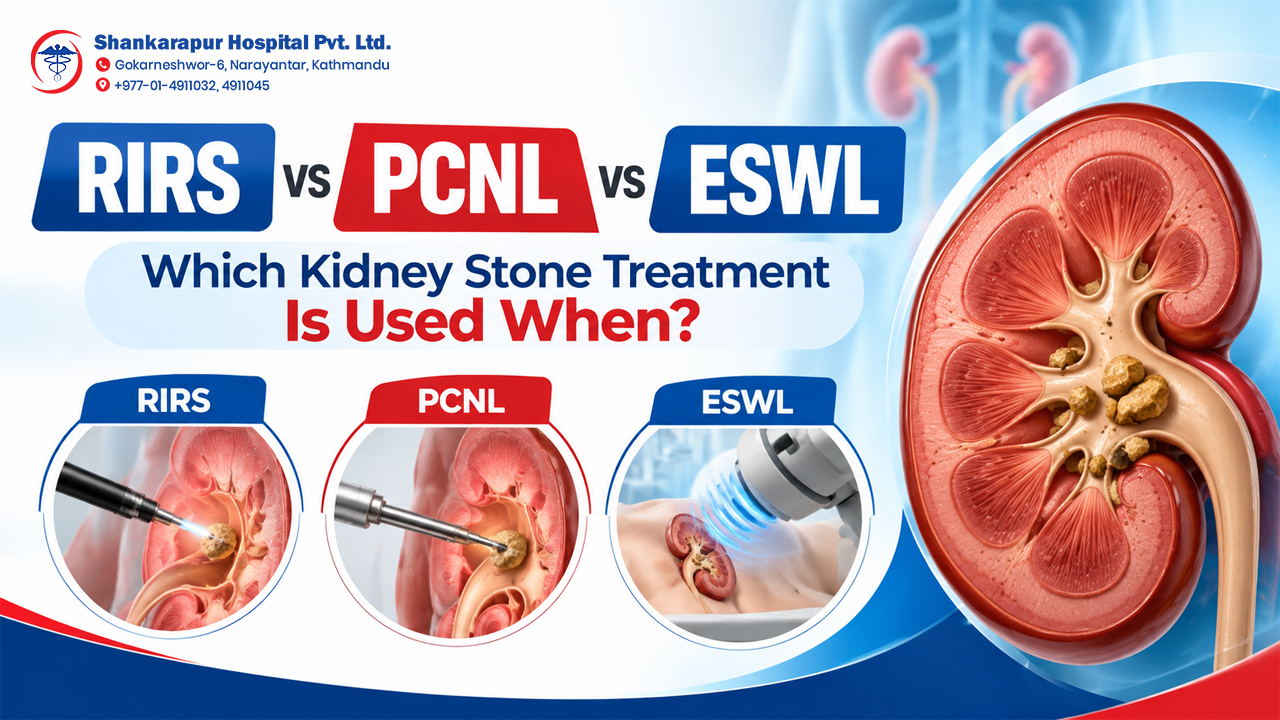
RIRS, PCNL and ESWL can all be used to treat kidney stones, but they are not interchangeable. ESWL is generally a less-invasive option for selected smaller stones, RIRS uses a flexible scope and laser to treat stones from inside the urinary tract, while PCNL is usually preferred for larger or complex kidney stones particularly renal stones larger than 2 cm. Stone location, density, kidney anatomy, infection, bleeding risk and the likelihood of needing repeat treatment can change the decision.
That means a 12 mm stone and another 12 mm stone do not necessarily receive the same treatment.
This guide explains RIRS vs PCNL vs ESWL, when each approach may be considered, their practical advantages and limitations, and the information a urologist uses before recommending one procedure.
For a broader overview of observation, surgery and other options, see Shankarapur Hospital's guide to kidney stone treatment options in Nepal.
RIRS vs PCNL vs ESWL: What Is the Main Difference?
The simplest distinction is how the doctor reaches or treats the stone.
RIRS reaches the kidney through the body's natural urinary passage using a flexible ureteroscope. The stone is visualised directly and generally fragmented with laser energy.
PCNL reaches the kidney through a small tract created through the skin of the back. A nephroscope is passed directly into the kidney so larger amounts of stone can be fragmented and removed.
ESWL, more commonly abbreviated simply as SWL in current guidelines, does not require a scope to reach the kidney. Shock waves are focused on the stone from outside the body so the stone breaks into smaller fragments that can subsequently pass through the urinary system. NIDDK describes shock-wave lithotripsy as breaking a stone into smaller pieces that then pass through the urinary tract.
| Factor | RIRS | PCNL | ESWL/SWL |
|---|---|---|---|
| Access | Natural urinary passage | Small tract through the back | No urinary-tract incision |
| Stone treatment | Usually laser fragmentation ± extraction | Direct fragmentation and removal | Shock waves fragment stone |
| Often considered for | Selected small-to-moderate renal stones, including many lower-pole stones | Large, complex or high-burden renal stones | Selected smaller renal/ureteral stones |
| Guideline direction for >2 cm renal stones | Selected alternative when PCNL unsuitable; staging may be required | Usually first-line | Generally not first-line |
| Lower-pole stones >1 cm | Common option | Common option | Less favourable in many cases |
| Main advantage | Direct endoscopic treatment without back incision | Strong clearance potential for large burden | Least invasive of the three |
| Main limitation | May require staged treatment for large burden | More invasive; bleeding/infection risks | Fragment clearance and retreatment can be issues |
Current EAU guidance strongly recommends PCNL as first-line treatment for renal stones over 2 cm and recommends PCNL or RIRS for lower-pole stones over 1 cm when the effectiveness of SWL is limited.
The table is therefore a starting point not a prescription. The correct choice depends on what imaging and clinical assessment show.
Why Doesn't Stone Size Alone Decide the Treatment?
Stone size is important, but it is only one part of treatment selection. A urologist may also consider stone location, total stone burden, composition or density, kidney anatomy, obstruction, infection, previous treatment, medication use and patient priorities.
The EAU currently classifies stones into size groups including below 5 mm, 5–10 mm, 10–20 mm and above 20 mm for treatment algorithms. It also notes that the success of shock-wave treatment is influenced by stone size, location, composition, patient habitus and treatment performance.
A useful way to understand the decision is through six questions.
1. How large is the total stone burden?
A single 8 mm stone represents a very different treatment problem from a 28 mm stone occupying a large part of the collecting system.
For renal stones greater than 20 mm, current EAU guidance states that PCNL should generally be the primary treatment because SWL may require multiple sessions and can increase the chance of obstruction from fragments. RIRS may still be used when PCNL is unsuitable or in selected circumstances, but staged procedures can be necessary.
2. Where exactly is the stone?
Location changes both access and the likelihood that fragments will clear.
A stone in the renal pelvis is not equivalent to one sitting deep in a lower-pole calyx. After ESWL breaks a lower-pole stone, gravity and renal anatomy can make it harder for fragments to leave the calyx.
The EAU therefore notes that SWL clearance is generally less favourable for lower-pole stones and identifies PCNL or RIRS as important alternatives, particularly once the stone exceeds 1 cm.
For stones located mainly in the ureter rather than inside the kidney, standard ureteroscopy versus SWL is often a more relevant comparison than RIRS versus PCNL. NICE, for example, recommends different approaches according to ureteric stone size and clinical circumstances.
3. How hard is the stone?
Different stone compositions respond differently to shock waves.
The EAU identifies calcium oxalate monohydrate, brushite and cystine among stones that can be relatively resistant to SWL. CT density can also contribute useful information: stones with a density above approximately 1,000 Hounsfield units on non-contrast CT are less likely to fragment successfully with SWL.
That does not mean a CT number alone determines treatment. It means density becomes one of several pieces of information used alongside size and location.
4. Is the kidney anatomy favourable?
Anatomy particularly matters for lower-pole stones.
A steep infundibulopelvic angle, long calyx, narrow infundibulum and long skin-to-stone distance can make SWL less effective. Challenging lower-pole anatomy can also make flexible endoscopic access more difficult in some cases.
This is one reason two patients with stones of the same diameter may receive different recommendations.
5. Is infection or obstruction present?
This can completely change the order of treatment.
An obstructed kidney accompanied by signs of urinary infection or anuria is a urological emergency. Current EAU guidance recommends urgent decompression when required and delaying definitive stone removal until infection has been treated.
In other words, the urgent question may initially be “How do we safely drain the kidney?”, not “Should we use RIRS, PCNL or ESWL today?”
6. Are there patient-specific factors that change procedural risk?
Pregnancy, anticoagulant or antiplatelet therapy, bleeding disorders, anaesthetic risk and body habitus can influence the choice.
SWL is contraindicated during pregnancy, while both SWL and PCNL require particular caution around bleeding risk. EAU guidance notes that ureteroscopy can sometimes provide an alternative where an uncorrected bleeding disorder or continued antithrombotic treatment makes other approaches problematic, although treatment decisions must still be individualized.
This is why choosing a procedure from stone size alone or from a friend's previous treatment is unreliable.
What Is RIRS for Kidney Stones?
Retrograde intrarenal surgery, or RIRS, is a flexible endoscopic procedure that reaches the kidney through the urethra, bladder and ureter without creating an incision through the back.
RIRS is essentially flexible ureteroscopy performed inside the kidney. After the flexible scope reaches the collecting system, the urologist identifies the stone. Laser energy can then fragment or “dust” the stone, and selected pieces may be extracted.
Modern flexible ureteroscopy commonly uses holmium:YAG or thulium-fibre laser technology for stone fragmentation.
Readers wanting a procedure-specific explanation can also review Shankarapur Hospital's guide to laser surgery for kidney stones.
When may RIRS be considered?
RIRS can be particularly useful for:
- selected kidney stones where direct endoscopic treatment is desirable;
- lower-pole stones for which SWL has less-favourable predictors;
- stones resistant to shock-wave fragmentation;
- patients in whom PCNL is not the preferred approach;
- selected stones where previous SWL was unsuccessful; and
- some larger stones when PCNL cannot be performed, although more than one procedure may be required.
For renal stones above 2 cm, RIRS is generally not automatically equivalent to PCNL as a first-line choice. Current EAU guidance favours PCNL and cautions that flexible ureteroscopy for larger stones may require staged procedures.
What are the advantages of RIRS?
One attraction is that the surgeon can directly see and treat the stone while avoiding a percutaneous tract through the back.
Compared with ESWL, RIRS also removes dependence on the patient's ability to pass all fragments created externally. It can therefore be useful when stone density, location or anatomy makes shock-wave treatment less attractive.
What are its limitations and risks?
RIRS still requires endoscopic instrumentation and usually anaesthesia. The urologist must navigate the ureter and kidney safely, and a temporary ureteral stent may sometimes be necessary.
Potential complications of ureteroscopy include infection, ureteral injury, bleeding and rarely more serious ureteral damage. The EAU reports that most URS complications are minor but identifies urosepsis as an important severe complication and stresses prevention through infection assessment, appropriate antibiotics and careful procedural planning.
Large or complex stone burdens can also require more than one RIRS session.
What Is PCNL for Kidney Stones?
Percutaneous nephrolithotomy, or PCNL, removes kidney stones through a small access tract created through the patient's back directly into the kidney.
The surgeon passes a nephroscope through the tract, fragments the stone as needed and removes the pieces. Because PCNL provides direct access capable of dealing with a larger stone volume, it occupies an important role in large and complex renal stones.
When is PCNL usually preferred?
The clearest guideline threshold is a renal stone burden greater than 2 cm.
Current EAU recommendations state that PCNL should be first-line treatment for larger renal stones above 2 cm. Complex and staghorn stones are also generally approached primarily with PCNL, sometimes with combined endoscopic techniques when clinically appropriate.
PCNL may also be relevant below 2 cm in selected situations for example, when a high probability of clearance is important and the balance of stone location, anatomy and other factors favours a percutaneous approach.
Why isn't PCNL used for every stone if it removes more stone directly?
Because greater treatment power comes with greater invasiveness.
For stones between 10 and 20 mm, the EAU notes that mini-PCNL can achieve higher stone-free rates than RIRS or SWL in some evidence, but this comes with higher bleeding risk and longer hospital stay.
The objective is therefore not to choose the most aggressive procedure. It is to choose the approach whose expected benefits justify its burden and risks for that particular stone.
What risks should patients understand?
PCNL can involve bleeding, infection, injury to surrounding structures, postoperative drainage requirements and further procedures for residual stones.
A large review cited in the EAU guideline recorded fever and transfusion among the more frequent complications and much lower rates of thoracic complications, sepsis and organ injury. Those published rates come from pooled populations and should not be presented as an individual's predicted risk because outcomes vary with stone burden, patient health, technique and centre experience.
Before PCNL, CT imaging is important for understanding the kidney, stone distribution and surrounding organs so the access tract can be planned safely.
Shankarapur Hospital's Diagnostic and Imaging Services currently list CT, ultrasound and digital X-ray services.
What Is ESWL for Kidney Stones?
Extracorporeal shock-wave lithotripsy ESWL or SWL uses focused shock waves from outside the body to break a stone into fragments small enough to pass through the urinary tract.
Its major attraction is the absence of an endoscope passed to the kidney or a tract created through the back.
NIDDK describes SWL as an outpatient procedure in which shock waves break kidney stones into smaller pieces that subsequently pass through the urinary tract.
When may ESWL be a good option?
SWL can work well for selected renal stones up to approximately 20 mm, particularly when the stone is located favourably and is likely to fragment. Current EAU guidance notes, however, that success decreases as stone burden rises and is less favourable for many lower-pole stones.
Its suitability is influenced by:
- size;
- location;
- stone composition and hardness;
- skin-to-stone distance;
- kidney anatomy;
- whether the stone can be accurately targeted; and
- whether the patient can safely undergo the procedure.
Why might ESWL require another treatment?
The procedure breaks the stone rather than physically removing all fragments.
Some fragments may not pass completely. Larger stone burdens are more likely to need repeated sessions or additional intervention. An accumulation of fragments in the ureter is known as steinstrasse, which can interfere with urine passage.
That makes “least invasive” different from “least likely to require another procedure.”
When may SWL be unsuitable?
Important contraindications identified by the EAU include pregnancy, uncontrolled urinary infection, certain uncorrected bleeding disorders, anatomical obstruction below the stone, and situations in which severe obesity or skeletal anatomy prevents reliable targeting.
Hard stone composition and unfavourable lower-pole anatomy are not necessarily absolute contraindications, but they can reduce the probability of successful clearance.
Important local note: Shankarapur Hospital's current Urology Department page explicitly lists PCNL, URS and RIRS but does not currently list ESWL among its key kidney-stone services. Patients should therefore confirm current ESWL availability directly rather than assuming it is performed onsite.
RIRS vs PCNL vs ESWL by Stone Situation
A practical comparison becomes easier when applied to actual stone patterns.
The following examples are hypothetical educational scenarios, not individualized treatment recommendations.
Scenario 1: A smaller stone in a favourable renal location
Suppose imaging shows a relatively small renal-pelvis stone without infection or obstruction and with characteristics favourable for shock-wave fragmentation.
In this situation, ESWL or RIRS may both be reasonable possibilities depending on exact measurements, stone density, anatomy, patient preferences and local expertise. ESWL offers lower invasiveness; RIRS offers direct visual treatment and may reduce dependence on spontaneous fragment clearance.
The useful question is not simply, “Which procedure is better?” It is, “What is the estimated chance that this stone will clear with one SWL session versus one endoscopic procedure?”
Scenario 2: A 12–15 mm lower-pole kidney stone
Lower-pole location changes the calculation.
Fragments produced by SWL may have difficulty leaving the lower calyx, particularly when anatomy is unfavourable. EAU recommendations therefore support RIRS or PCNL for lower-pole stones over 1 cm when SWL efficacy is limited.
RIRS may offer a useful balance between invasiveness and direct treatment. Mini-PCNL may offer stronger clearance in some circumstances but introduces percutaneous-access risks.
The best option depends on anatomy, stone density and the importance of achieving clearance with the fewest possible procedures.
Scenario 3: A 25–30 mm renal stone
Once total renal stone burden exceeds 2 cm, the treatment direction becomes clearer.
PCNL is generally the first-line guideline recommendation. RIRS or SWL may still be considered when PCNL is unsuitable, contraindicated or declined after appropriate counselling, but patients should understand that multiple treatment sessions or additional procedures may become more likely.
This is a useful example of why choosing the “least invasive” technique is not always the least burdensome overall. Two or three procedures can create a different treatment burden from one appropriately selected procedure.
Scenario 4: A hard stone with high CT density
Suppose a moderate-size stone appears very dense on non-contrast CT or previous analysis shows a shock-wave-resistant composition.
That finding may make RIRS or PCNL more attractive than ESWL, because direct endoscopic or percutaneous fragmentation does not depend as heavily on the stone's susceptibility to external shock waves. EAU guidance specifically advises considering stone composition and CT characteristics when selecting treatment.
Scenario 5: Stone plus fever and urinary obstruction
This is not primarily a RIRS-versus-PCNL-versus-ESWL decision.
When obstruction occurs with infection or sepsis, urgent drainage and infection treatment take priority over definitive stone removal. The collecting system may be decompressed with a ureteral stent or percutaneous nephrostomy, with definitive stone treatment postponed until the infection is controlled.
For patients in Kathmandu who have severe stone symptoms accompanied by fever, chills, reduced urine output or significant deterioration, Shankarapur Hospital lists 24-hour Emergency & Critical Care services.
What Tests Help Decide Between RIRS, PCNL and ESWL?
A procedure should normally be chosen after the stone and patient's clinical condition have been adequately assessed.
A urologist may use some combination of:
| Assessment | Why it matters |
|---|---|
| Ultrasound | Can identify stones, obstruction and hydronephrosis |
| Non-contrast CT | Defines size, location, burden, anatomy and stone density |
| Urinalysis | Looks for blood and possible infection |
| Urine culture | Important when infection is suspected or intervention is planned |
| Blood tests | Can assess renal function and relevant clinical risks |
| Previous stone analysis | May indicate stone composition and SWL resistance |
| Medical/medication history | Identifies bleeding, anaesthetic and other procedural risks |
EAU guidance states that urinary infections should be treated before stone removal and that urine culture or urinary microscopy should be performed before treatment.
At Shankarapur Hospital, current diagnostic services list CT, ultrasound and digital X-ray, while the Urology Department provides specialist assessment for kidney-stone management.
Contextual CTA
If you have already been told that you may need RIRS, PCNL or another stone procedure, the useful next step is not to choose the operation from an online comparison. Bring your imaging reports, urine/blood results, medication list and previous stone records to a urology assessment so the recommendation can be based on your actual stone.
Shankarapur Hospital's Urology Department currently lists kidney-stone management including PCNL, URS and RIRS.
Which Procedure Has the Easiest Recovery?
There is no single recovery timeline that applies to every patient, but the relative invasiveness differs.
ESWL generally has the least invasive access because no endoscope reaches the kidney and no back tract is created. Its trade-off is that patients must pass fragments afterward and some may need further treatment.
RIRS avoids a back incision but involves ureteroscopic instrumentation under anaesthesia. NIDDK notes that people undergoing ureteroscopy can typically go home the same day, although individual practice and clinical circumstances vary.
A temporary ureteral stent may sometimes be placed after ureteroscopy. Not every uncomplicated URS requires a stent, according to current EAU guidance.
PCNL generally creates greater procedural burden because a tract is made directly into the kidney. However, modern miniaturised and tubeless techniques can reduce postoperative burden in properly selected patients. The EAU notes that totally tubeless PCNL in uncomplicated cases can shorten hospital stay without increasing complications.
Recovery should therefore be discussed in terms of the actual procedure planned rather than simply the acronym.
Useful questions include:
- Will I need a ureteral stent or nephrostomy tube?
- How long is it expected to remain?
- Is the procedure intended as day surgery or admission?
- What activities should I avoid afterward?
- What symptoms should trigger urgent reassessment?
- When will follow-up imaging confirm stone clearance?
Which Treatment Is Most Likely to Clear the Stone in One Procedure?
There is no universal answer, because clearance depends on the stone being treated.
For large renal stones, PCNL generally offers an important clearance advantage and remains guideline-recommended first-line treatment above 2 cm.
For smaller and moderate stones, RIRS can provide direct treatment while avoiding percutaneous access.
For appropriately selected smaller stones, ESWL can offer an attractive lower-morbidity approach, but its success is more sensitive to size, location, hardness and anatomy, and repeat treatment may be needed.
A better shared-decision question is:
“For my specific stone, what is the expected chance of clearance with one treatment, and what would the next step be if residual fragments remain?”
That question forces the comparison to include the entire treatment pathway rather than the first procedure alone.
What About the Cost of RIRS, PCNL and ESWL in Nepal?
Procedure price should not be treated as a fixed universal number.
Total cost can vary with:
- investigation and imaging requirements;
- anaesthesia;
- disposable equipment;
- laser or other technology used;
- complexity and number of stones;
- stent or nephrostomy requirements;
- hospital admission;
- medications and laboratory testing;
- need for a second procedure; and
- follow-up imaging.
Because current procedure-specific prices were not verified from Shankarapur Hospital's official service pages during this research, this article should not publish estimated Shankarapur prices as factual charges.
Patients should request an estimate only after the planned procedure and likely treatment pathway are clear.
Is RIRS Better Than PCNL?
RIRS is not universally better than PCNL, and PCNL is not universally better than RIRS.
For a moderate stone where both are clinically reasonable, RIRS may appeal because it avoids percutaneous access. For a large stone burden above 2 cm, however, PCNL generally becomes the preferred first-line treatment because it is better suited to removing a large volume of stone.
The comparison should therefore focus on the clinical goal.
If the objective is treating a relatively manageable stone through the natural urinary tract, RIRS may fit well.
If the objective is clearing a large or complex stone burden efficiently, PCNL may provide a stronger solution.
Is RIRS Better Than ESWL?
RIRS generally provides more direct control over stone fragmentation because the surgeon reaches and visualises the stone.
ESWL is less invasive but depends more heavily on the stone fragmenting effectively and the fragments subsequently clearing.
Lower-pole anatomy, resistant stone composition and higher density may therefore move the decision toward RIRS. Conversely, a smaller, favourably positioned stone that is likely to fragment may make ESWL attractive.
Neither option wins the comparison without knowing the stone.
Is PCNL Better Than ESWL?
For large renal stones, PCNL is generally the more appropriate comparison winner because current guidelines recommend it as the primary approach for stones over 2 cm.
For a small favourable stone, however, the greater invasiveness of PCNL may not be justified when SWL or RIRS could reasonably achieve the treatment objective with lower procedural burden.
“Better” therefore means best matched to the stone and patient, not strongest technique in isolation.
What Should You Ask Before Agreeing to Kidney Stone Surgery?
Patients can make a more informed decision by asking the urologist questions that reveal why a particular procedure has been recommended.
- What is the exact size and total burden of my stone?
- Is it in the renal pelvis, upper/middle calyx, lower pole or ureter?
- Is there any obstruction or hydronephrosis?
- Is there evidence of urinary infection?
- What does the CT suggest about stone density?
- Why are you recommending this procedure over the other options?
- What is the likelihood that I will need another procedure?
- Will I need a ureteral stent or nephrostomy?
- What are the major risks in my individual case?
- How will we confirm that the stone has cleared?
- If the stone is retrieved, will it be analysed?
- What should we do afterward to reduce recurrence?
These questions are useful because kidney-stone treatment is both a technical decision and a shared decision. The most appropriate option balances clearance, complications, recovery and patient preferences rather than focusing on only one measure.
What Happens After the Stone Is Removed?
Removing today's stone does not necessarily address why the stone formed.
Stone analysis, medical history, blood testing, urine testing and in selected recurrent or high-risk patients more detailed metabolic evaluation may help guide prevention.
Patients who have already undergone treatment can continue with Shankarapur Hospital's guide on kidney-stone recurrence and metabolic evaluation.
The goal after surgery should therefore be twofold:
confirm adequate stone clearance, then reduce the likelihood of another stone where possible.
Key Takeaways: RIRS vs PCNL vs ESWL
RIRS, PCNL and ESWL each solve a different type of kidney-stone problem.
ESWL offers a non-endoscopic approach for selected stones but is strongly affected by size, location, hardness and anatomy.
RIRS reaches kidney stones through the urinary tract and can be particularly useful for selected small-to-moderate stones and many lower-pole stones.
PCNL provides direct percutaneous access and remains the principal first-line option for renal stones larger than 2 cm and many complex stone burdens.
Most importantly, stone size is only the beginning of the decision. Imaging findings, stone location and composition, kidney anatomy, infection, obstruction, medication use, overall health and the probability of needing additional treatment should all be considered.
If you have kidney-stone imaging and need to understand which treatment approach may fit your case, you can arrange a urology assessment through the Shankarapur Hospital Urology Department or contact Shankarapur Hospital.
FAQs
Which is better: RIRS, PCNL or ESWL?
There is no universally best procedure. PCNL is generally preferred for renal stones above 2 cm, while RIRS and ESWL can be appropriate for selected smaller stones. Lower-pole location, stone hardness, anatomy, infection and patient factors can change the recommendation.
Which procedure is usually used for a kidney stone larger than 20 mm?
PCNL is generally recommended first-line for renal stones larger than 20 mm. Flexible ureteroscopy/RIRS or SWL may be considered when PCNL is unsuitable, but additional treatment sessions may be required.
Is RIRS the same as laser kidney stone surgery?
RIRS commonly uses laser lithotripsy, but the terms are not completely interchangeable. RIRS describes flexible retrograde endoscopic access into the kidney; laser lithotripsy describes the energy used to fragment the stone.
Does RIRS require an incision?
RIRS generally reaches the kidney through the urethra, bladder and ureter, so it does not require a skin incision into the kidney. A temporary ureteral stent may sometimes be used afterward.
Does PCNL require a cut?
PCNL requires creation of a small percutaneous access tract through the back into the kidney. Modern techniques use relatively small tracts, but the procedure remains more invasive than RIRS or ESWL.
Can ESWL treat a 20 mm kidney stone?
SWL can achieve useful results for selected renal stones up to about 20 mm, but effectiveness depends strongly on location, density and anatomy. Lower-pole stones and hard stones can be less favourable candidates.
Why is ESWL less successful for some lower-pole stones?
The stone may fragment successfully but pieces can remain trapped in the lower calyx because of anatomy and gravity. A steep infundibulopelvic angle, long calyx and narrow infundibulum are among factors associated with poorer SWL clearance.
Can a kidney stone with infection be treated immediately?
When obstruction occurs together with infection or sepsis, urgent drainage and infection treatment generally take priority. Definitive stone removal is usually delayed until the infection has been controlled.
Can the same patient need more than one kidney-stone procedure?
Yes. Large stone burdens, difficult anatomy, incomplete fragmentation or residual stones can require staged RIRS, repeated SWL or an additional procedure. The expected chance of needing another treatment should be discussed before the first procedure.
Does Shankarapur Hospital provide RIRS and PCNL?
Its current Urology Department page explicitly lists kidney-stone management including PCNL, URS and RIRS. ESWL is not listed on that service page, so current ESWL availability should be confirmed directly with the hospital.